Press & media
Press kit
Sensemaking is the independent home of a research group studying how to operate when the unknown is the operative condition. This page collects the fact sheet, key messages, spokesperson details, and downloadable assets for reporters covering the work.
Fast facts
- What it is
- Sensemaking is the independent home of a research group studying sensemaking: the discipline of reading ambiguous evidence under stakes.
- Origin
- Confronting Unknowns, a transdisciplinary, non-credit independent activity at MIT. The inaugural cohort convened in January 2026: 55 engineers, analysts, operators, and researchers from 16 institutions, over two days on campus.
- Flagship work
- Confronting Unknowns: A Framework for Anomalous Aerospace Events, a paper co-authored by the ’26 cohort. It proposes a four-stage pipeline (detect, identify, respond, explain) for events that resist immediate attribution.
- Methods
- Open-source intelligence, systems-theoretic hazard analysis, cognitive bias diagnostics, and scenario-based wargaming.
- MIT relationship
- JMill conducts Confronting Unknowns, a non-credit independent activity at MIT. It is not a for-credit course or an official MIT academic program. The research publishes independently as Sensemaking, which is not an MIT-published property.
Key messages
Sensemaking is a teachable leadership skill.
It is a method, not an aptitude. Confronting Unknowns brings it to working engineers, analysts, and operators, and modern aerospace safety depends on it operating at machine speed.
The gap is structural.
Autonomous drone swarms near military installations, satellite-navigation spoofing along commercial flight corridors, sensor returns that defy classification: each exposes the space between what sensors detect and what institutions can make sense of.
Methods, not positions.
The framework disciplines how evidence is read before any conclusion is drawn. It is agnostic about what anomalous events turn out to be.
Independent and accountable.
Sensemaking publishes under its own name and stands behind its own claims. The work draws on MIT and on collaborators across many institutions, but it speaks only for itself.
Briefing documents
- Congressional briefingCongressional Briefing: Confronting Unknowns — the cohort’s recommendations for a safer, more effective, and more just approach to disclosure: better tools for frontline operators, a governed science infrastructure, and rebuilt public trust.
Selected coverage
- TIME“America Is Finally Taking Extraterrestrials Seriously” (opens in new tab) by Jeffrey Kluger. Cover story of the August 17, 2026 issue, published online August 6, 2026. The story features the Confronting Unknowns program and quotes JMill.
- Disclosure Foundation“Confronting Unknowns at MIT: Sensemaking and UAP Research” (opens in new tab) by Jordan Flowers, published June 24, 2026. Profiles the program and the Sensemaking research group.
Spokesperson
Jonathan “JMill” Miller. Bio and contact: sites.mit.edu/jmill.
Downloadable assets
Free to use in coverage of Sensemaking and the Confronting Unknowns program.
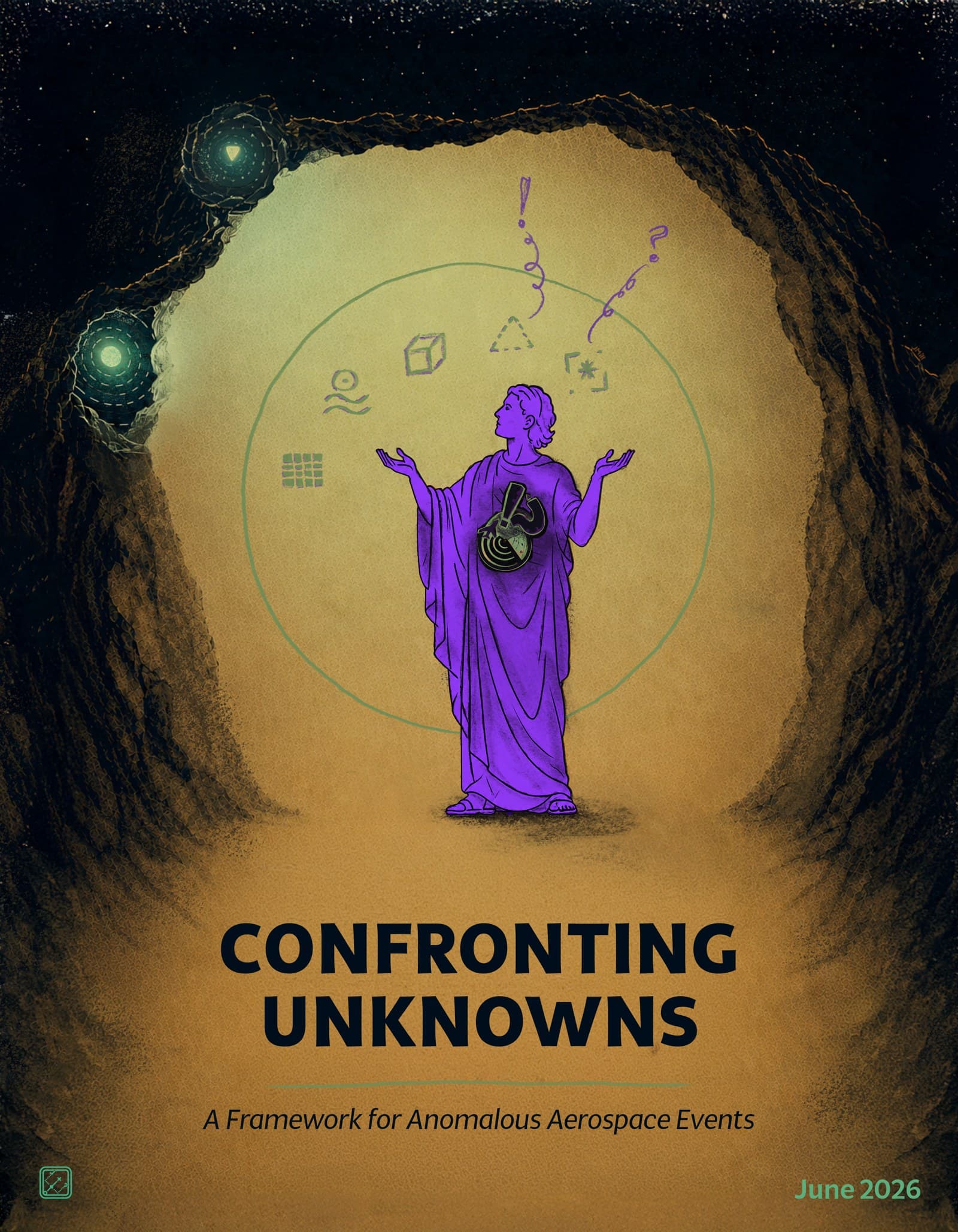

Artwork and design by Jonathan “JMill” Miller. Please credit reproductions to JMill / The End Effector.
Media contact
For interviews, advance copies, or fact-checking: jmill@mit.edu. Background on the program lives at sites.mit.edu/jmill/confronting-unknowns.
Sensemaking is operated independently and is not an MIT-published property. JMill conducts Confronting Unknowns, a non-credit independent activity at MIT; the research publishes here. Positions published on this site belong to their authors, not to MIT.